The 25 January Revolution in 2011 and the 30 June uprising in 2013 reflected one of the noblest and most peaceful events, in which the Egyptian youth led the revolutionary vanguard, overcoming the restrictions surrounding them.
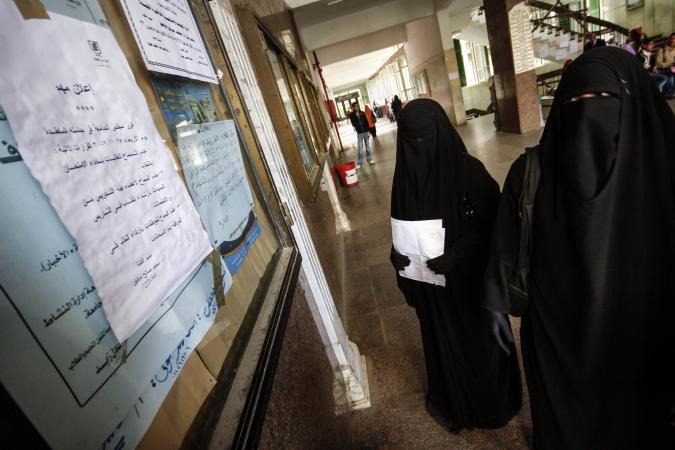
Gaber Nassar sits in his ornate office, behind a huge oak desk covered with piles of papers as he explains why the university he leads recently banned women from teaching while wearing the niqab, a veil that covers the face but reveals the eyes. "Everyone has the right to dress how they want, but on one condition: Don't break the rules," says Nassar, the president of Cairo University, one of Egypt's oldest academic institutions.
Mr.President, I would like to know who thinks with you. Who takes decisions without consulting with you? Who is causing your reputation to decline? Who is responsible for the continuous wasting of the looming opportunities? Mr President, do not believe those whispering to you, saying that your elite can convince the people with what you want. The people no longer believe the lying elite. Actually, Egypt no longer has elite. Do not believe those whispering to you saying that the angry youth stand on shaking ground and that the people trust them no more. The opposite is true; the people await hope for change. I absolutely do not mean you. I mean the change the people have been waiting for since January 2011.
I never met Giulio Regeni. However, for the past 10 days since his disappearance I have reached out to mutual friends of ours in a desperate attempt to put together the fractured pieces about the theft of this beautiful stolen soul. The past five years in Syria, Egypt, and the Mediterranean have been years of mourning. Like myself, Giulio was a student at the University of Damascus in 2010. He had spent years of his life mastering the Arabic language between Damascus, London, and Cairo. He lived life between languages. His work as a PhD student was to piece together the fragments of information we can find on labour movements in Egypt. His passion was to render visible those lost bodies under the yolk of production and capital. Giulio was able to translate what so often is lost: the memory and hope for dignity and life in between home and exile.
On the first day of Ramadan in summer 2014, the Islamic State in Iraq and Syria (also known as Daesh) declared itself the new Caliphate. A few days later it put out, in print and on-line, its first issue of Dabiq, a glossy magazine, as its mouthpiece to the English-speaking public. Similar magazines were also issued in Russian, Turkish, French and other languages. Dabiq continues to publish, with 13 issues over 19 months so far, averaging 60 pages in an issue.
The fall of oil prices during the last year and a half has been dramatic, starting in autumn 2014 where the price kept fluctuating in downward spiralling cycles, until it reached its current level of under $30 per barrel. For those who does not remember, repairing the oil price collapse that occurred in 1986 after some OPEC members followed a dumping policy took 14 years until prices returned to the above $20 per barrel level, with the exception of the nine months around Iraq’s occupation of Kuwait when oil wells were in flames.
The fifth anniversary of the revolution should have seen an Egypt where the roadmap was completed with the election of a new parliament, the country was on the road to security and stability, and the people had begun to reap the fruits of economic development.
an article titled “Happy New Yearâ€, I said that 2015 was a bright year for Egyptian cinema and that I was confident that 2016 would continue to be a success. Since the beginning of 2016, there have been signs that a different kind of filmmaker is entering the arena. News broke out during the last week that five Egyptians films will be showcased at the 2016 Berlin Film Festival in the Forum; this is the highest Egyptian participation in the festival yet. Four of these films will be debuts for their creators, featuring Mayye Zayed’s “Sunflower Memoryâ€, Islam Kamal’s “Expiredâ€, Maged Nader’s “Fathy Doesn’t Live Here Anymoreâ€, Heba Amin’s “As Birds Flyingâ€, and Tamer Saeed’s feature film “The Last Days of the Cityâ€.
President Xi Jinping went from Riyadh to Iran this month to become the first foreign leader to do so following the lifting of international sanctions against the Islamic republic. Saudi leaders could not have been pleased. China and Saudi Arabia (and Egypt) signed $55bn worth of cooperation agreements during Xi’s visit, including a nuclear cooperation pact. Yet Xi’s determination to gain a first-mover advantage in Iran, at a time that Saudi Arabia is seeking to increase rather than reduce the Islamic republic’s international isolation, suggests that more than commerce is at play here.
What has happened in the five years since the 25 January Revolution? This is a question that has been raised by many, with many others believing they have the answer to it.
The more the ISIS (Islamic State in Iraq and Syria) menace expands, the more fighting terrorism on the military and security levels acquires an absolute priority. This is quite evident since the Paris attacks on 13 November.
I intended to write about the fifth anniversary of the 25 January revolution this week, to join in the conversation carried out over valuable articles and comments by colleagues and friends. But I’ll postpone that for a week in view of the urgency of commenting on the rejection by parliament of the Civil Service Law, which will be resubmitted by the government next week.
One cannot deny truths when the facts are so obvious for everyone. There are those promoting hatred for the revolution as if it were an illegitimate act involving conspiracy against security forces and an undermining of their foundations. Others believe that maligning the revolution would further cement and stabilise the state.
The story of each year begins again on Monday. The state mobilises all forces to deal with those who dare and try to commemorate the January revolution. The … is preparing to commemorate the anniversary and the forces of … is preparing to ignite the revolution again. Other powers are trying to prove that the revolution was a huge mistake and a fourth power is trying to hold the stick from the middle.
A mixture of latent anger, disappointment and boredom has descended on the city that, although living up to its name “Al-Qahira†(the vanquisher) has always been full of life.
Tomorrow marks the fifth anniversary of the January 25 Revolution. As the years pass rapidly by, we sometimes forget who we were then, and don’t recognisee who we have become.
Daily News Egypt entered an important phase of its history, two years after its restructuring, leading it to stabilise last year after the difficult years that followed the 25 January Revolution in 2011. It has become a focal point of attention among the elites, thinkers, politicians, and economists of the country.
Brad L. Brasseur explores the current problems in creating good education for the socio-economically disadvantaged in developing nations and looks at some of the solutions. The United Nations recently claimed that the Millennium Development Goals (MDGs) that focused on primary education increased global enrolment from 83% to 91%. Despite these gains, today it is estimated that 124 million children do not attend school and 757 million adults are illiterate.
As of January 10th, the parliament has 15 days to review all 340 laws issued over the past two years. Under Article 156 of the constitution, it must decide whether to endorse or reject them.
The end of a year and beginning of another is always a good chance to assess performance of the economy by analysing different indicators, taking into consideration the performance of different sectors, government policies, and the role of the private sector.
Up until recently, the distance between the East and the West was too long and terrain challenging to measure accurately. Seas and oceans stood in in the way and took months to cross. Modern transportation helped make the geographic distance easier to cover. However, the cultural differences between East and West have been a much more demanding task. Modern electronic technology, cell phones, the Internet and social media such as Facebook and Twitter attempt to bridge the cultural divide. To date, these tools have complicated matters rather than helped. They have accentuated our deep societal differences. Separation has widened and the rejection of cultural distinctions has persisted.
Mina M. Azer
The Coptic Christians are used to eat taro and reeds at the feast of Epiphany, which commemorates the baptizing of Jesus Christ in Jordan River.
 The Epiphany